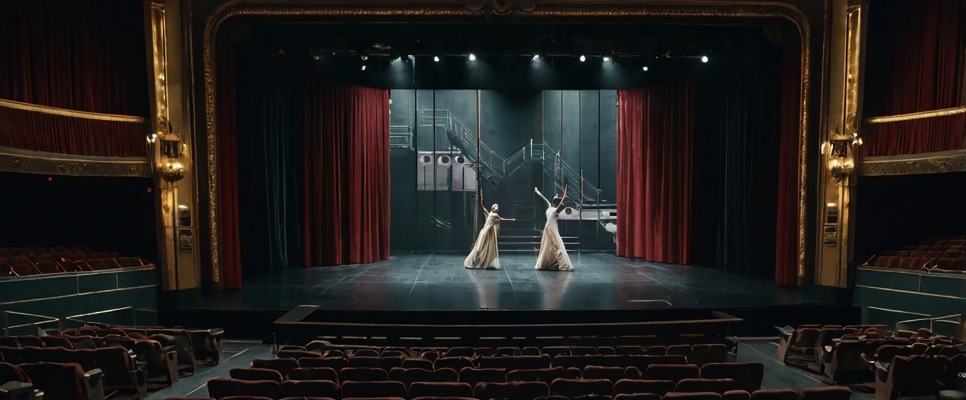
Live theater has persisted as a prominent form of culture in human history for thousands of years. In its genesis, there was storytelling with much reflection and communal participation. From the times of ancient rituals to today's theatre houses, it has been a mirror and mold of different societies through collective experiences which every so often last long after generations.
The theatre indeed transcends conventional limitations to manifest doctrines for societal values, teaching, and community togetherness. The secret of live theatre goes on in the relation between performer and observer stimulated by turn stilling for a moment in time and finally, it is done with tales.
Origins of Live Theatre
The roots of the living theater are old and deep in the history of human beings, commencing surely as rites of performance closely associated with religion; myth; and communal storytelling.
Ancient & Classical Theatre
Greek theatre formalized these early practices upon its emergence around the 6th century BCE. Amphitheatres such as the Theatre of Dionysus at Athens enabled grand audiences to gather, enhancing the aspect of communal storytelling. Greek tragedies and comedies were deeply concerned with human emotions, politics, and morality, and could involve direct actor-audience interaction. The Roman theatre borrowed from this tradition and, significantly, elaborated on various stage performances and spectacular events and activities. Both stages of development of human civilization were laid upon the ideas of narrative principle, dramatic conventions, and a basis of an interactive relationship shared between the spectators and the performers that are influential up to this day.
Eastern and Non-Western Theatre Traditions
While drama in the West developed in Greece and Rome, vibrant theatrical traditions were developed in Asia and Africa. In India, Sanskrit drama appeared as a fine conflux of music, dance, and dialogue, emphasizing spiritual and moral messages with the texts of the Natya Shastra directing its performance. As to Japan, forms like Noh and Kabuki made use of stylized movement, masks, and music in order to convey elaborate narratives, offering a fine blend of ritual and the entertainment. In contrast, African oral traditions made use of storytelling, dance, and drumming to enhance communal attentiveness as well as to keep heritage alive. These traditions go a long way in showing that the initial beginnings of theatre developed different ways and were globally interconnected in emphasizing their shared human expression across culture.
Medieval and Renaissance Theatre
In the aftermath of the Roman Empire, theatre gravitated more toward religious and community centers. During the medieval period, mystery or miracle plays were performed by layfolk, oftentimes disguised or characterizing religious themes, the Jewish God, Virgin Mary, and the saints, in pomp-filled attire, in order to describe with substantiation what is act and how it relate with an appreciating pursuit, where individual corporations within a big town, and beyond them, the people of an area, stand together in fine representation. Medieval theatre was inclusive, and its mascarons openly declared that minimalism was their least concern. The Renaissance embraced a plethora of classical ideas that led to theatrical innovations in dramatic writing, techniques of performance, and the design of permanent theatres. Public playhouses, like Shakespeare’s Globe, thereby became a kind of democratic ground where artistry was consummate and open to everyone: an accessible place maintained by community ties for their audience.
Early Popular and Folk Theatre
In the history of early popular theater and folk performance, these forms, alongside the religious and courtly, developed a uniquely respectable position in the matrix of communal culture. Here the wandering scholars and street entertainers would tell stories before the eyes of villagers and bystanders. Puppeteering, juggling, and episodes of improvisation provided a source of amusement while reflecting regional custom and social commentaries. With local traditions stressing on audience participation and flexibility, they themselves laid the underpinning for the modern community theater practice whose primary goal has been audience engagement and accessibility.
The Rise of Regional and Community Theatres
Besides the rapidly expanding cultural scene, between regional theater clubs and community theaters etc., the widening gap between large vanishing urban areas and many small-town or hidden districts started evolving-the latter usually helping performances reach their audiences by arranging for them to happen in harmony with community events or increasing audiences' membership greatly by decreasing culture-induced social differences in these successful recitations. These partners made sure that when theater-in-the-round must be struggled for, to protect and support relatively smaller, more accessible and local organizations within their local identity were the more obvious and polarized to what was to show out for that culture remained in the metro.
Community Impact
Local theatres, apart from being a source of entertainment, also serve their myriad of educational, social, and cultural purposes. Several parts of the population, including the youth, the amateur groups and societies, and numerous volunteer-action groups, have had many an opportunity to cross paths, to develop skills and learn from the experiences of older generations. The Oregon Shakespeare Festival and Canada's Stratford Festival, forest and established stand-alone regional theatres during their formative years, have each grown into cultural icons within their respective birth countries. All the while, they have not compromised their community essence. The theatres create a valuable case study on how small spaces can fetch civic pride and weaving in lifelong engagement with performing arts.
Architectural and Technical Evolution
The theater space design and technology play a critical role in how the audience experiences performances. The traditional proscenium stage, thrust stage, flexible, and black box theaters each provide interaction dynamics of their own. Centuries of lighting, acoustics, and set design trends-from oil lamps to digital soundscapes-help emphasize storytelling and the audience's sense of immersion. Tolerant to embrace the recent advancements, theaters in the regions prove they can act effectively and creatively in aspects other than those of metropolitan art theaters.
Cultivating Local Talent
Community theater sets the stage to incubate artists with opportunities to experiment, take creative risks, and gain practical experience in a nurturing environment. Numerous famous performers burgeoned from the humble confines of community theater, in which guidance and collaboration turned the fledgling into redoubtable theatrical giants. Such community theaters nourish local talent, helping both to brighten and illuminate the performing arts for their generations to come.
Community Festivals and Seasonal Productions
Local theaters serve as the anchor for cultural festivals and seasonal events. These plays create an opportunity for whole communities to come together. Some take place yearly, such as winter comedy, summer Shakespeare, or folk performances, thus providing consistency. It follows that the community respondents in creating a following and frequently attracts larger audiences with community involvement through schools, civic organizations, and local businesses, which ultimately becomes entertainment. Beyond the stage, it seems to extend.
Themes That Transcend Time
Certain facets of professional theater have quietly retained a hold across all the centuries: the art of storytelling in one form or another. Tradition and audience-spectator interactions reside as its core and remain unchanged. Alongside matter, style, and place of appearance, live performances fail to quite anything else, thereby bringing them alive in such a way that they resonate beyond all the differences.
Storytelling and Shared Experience
Theatre is inherently concerned with exposition of the emotional scope of humans, issues representative of society came to be engaged with, and stories that the world relates to. Theater enables an audience to relate, ponder the issues, and try to shine a light on their life experiences. This is also something live as interaction accentuates the process; the immediate feeling of watching a performance with the physical energies of the audience occurs, which establishes a tangibly intimate connection in a way that a digitally reproduced performance could not.
Preserving Cultural Heritage
Amateur theatre contributes greatly to the sustenance and celebration of cultural identity and fulfills these needs by providing platforms for the re-telling of local stories, conducting youth programs, providing the visibility of amateur engagement, thereby nurturing traditions while making the arts inclusive. A classic example is found: various regional theaters in Europe, in both North America, have in place extensive educational outreach programs, hence bringing classical and modern works before students, thereby guaranteeing that theatre's tradition of storytelling will continue to inspire unborn generations.
Fostering Empathy and Social Reflection
Plays provide a medium for interpreting social issues so audiences can entertain different views and cultural experiences. Pieces discussing issues such as inequality, immigration, or historical episodes leave scope for self-reflection and discussion, creating empathy among the audience. This unique quality of attention raises the status of theatre as a vehicle of entertainment and meaningful social commentary.
Celebrating Innovation and Creativity
Theatre, by its very nature, really has no definite boundaries that define styles in writing, performance, and production. The flow of the art that is theatre has always been there for its artists and audiences, not for the sake of the writer, nor the director, nor the critic, nor the audience. All the rest is icing on the cake.
The Modern Scene and Future Directions
Choosing the medium of performance above everything else celebrated theater; to learn, to be excited and frazzled; to imagine many things at once; discovery and exploration toward globalization. Theater must break free from the yoke of a false reality and create its own realms of reality. In justifying social justice, it prioritizes consciousness, then works towards power. The other levels are quite simpler. Without a doubt and overwhelmingly the reason why sparks fly up and theatre evolves as a permanent and dynamic profession for the present and future is creativity and constant renewal.
Current theatre is about tradition and innovation. Digital media, live-streaming, and hybrid performances are reaching new audiences and complementing, rather than supplanting, live performance. Community theatre is still a great success, with the sum total of efforts toward access, nurturing talent, and strengthening the connection between actors and audiences. Theatres try to remain on contemporary tracks with immersive theatre, interactive productions, and cross-boundary collaborations, while exploring society's societal inclination for play while clinging to the rudimentary ideas of theatre.
The Enduring Impact of Live Theatre
Live theatre survives not because of the stories it tells but because it cultivates, becomes culture, and engenders shared human experiences. In regional stages and community theaters, whether aged back for centuries or yet new, we thus find cultures, the community's soul beating from within. There is one thing for certain in this world and that is that an active live performance in the same space with an audience makes a connection for which no screen or recording can ever make up. And that's the wonder, challenge, beauty, and joy of keeping and keeping the theater alive across generations.