Live events have the ability to captivate, entertain, and touch everyone in some beautiful form; either it can be a concert, a small-theatre show, or a really large festival. What seems to be actually performed onstage; however, barely blinks the surface of being just one percent of the whole thing. Perfect cues, precision lighting, and smooth melodies absorb into a fabric woven with extreme technical skill, artistic vision, and coordination of those who do the actual work.
Knowledge of this other world intensifies the participants’ appreciation of live events and opens their eyes to the extent of organized teamwork and technical excellence required to pull off such live events. Every production aspect plays a part in a careful orchestration that moves to production almost indistinguishable from preparation.
Core Production Elements
Live performance is the primary blend of technical saber rusty and the arts that exist in the psychology of an interaction. Sometimes graphically organized, these factors open the spaces for a show's ambience, clarity, flow, and appeal.
Lighting Design
Lighting is more than simple illumination; it is the art of storytelling. Designers use lighting to draw attention, create mood, and to underscore changes in emotional states. From the subtle warmth of the first gentle rays to the dynamic color schemes which play within musical numbers, lighting crafts the audience's visual experiences.
Most of the common gear is composed of LED panels, moving heads, gobos, and dimmer boards. Designers will design cues to run with music, dialogue, or stage action. Lighting also interacts with sets and costumes: bright colors may get washed out in too bright lights, or shadows may be able to add dramatic depth. Proper lighting can transport a simple scene into a strong visual experience.
Sound Engineering
The sound holds great importance in live functions. Audio engineers see to it that dialogues, tunes, and effects are appropriately delivered to satisfy the audience. Working at mixing boards, these techies would also effectively implement the audio via means of microphones, speakers, and monitors.
In the presence of challenges such as feedback, unintentionally poor acoustics, and timing issues, engineers have to remain watchful. The instantaneous projection of the sound around an environment necessitates formidable skills in adjusting levels. They also would make a multitude of quick audio adjustments either to adjust the sound and obtain crystal clear output with absolute clairvoyance or adapt at performing art by fitting it into timeline deadlines in front of the audience packed inside a live auditorium.
Stage Management
The people behind the scenes with eyes and ears on almost everything are, thereby, stage managers. They call cues, keep time, and become the central links among the actors, the techs, and the director.
Amplify calls may vary from lighting to securing the set or sudden actor demand. In a performance panic, they're there to take their stand solving problems and may have to replace a prop that the actor just broke. They translate pieced-together rehearsal plans into a seamless live reality.
Rehearsals and Timing
Rehearsals are melodramatic and an art of living--a most necessary opposite to the presented play. It is a necessary place to develop within the space of a room, the fourth dimension of abstract entity. In other words, rehearsals are a fusion involving the obnoxious spheres of the ambulant players and the timid technicians. They need not only to move in the general time together but also to ferry in the co-ordinates of their own looping arrangement. From beginning to the long awaited opening night, a typical rehearsal includes the rough staged rehearsal.
Artistic and Human Elements
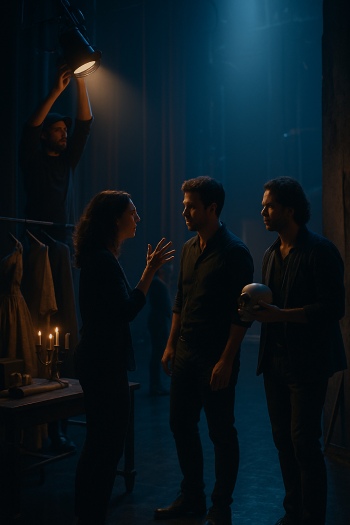
Technical know-how is excitingly part of production, while the imaginations and human aspects put a soul into the performance. Casting, artistic design, and form in turn affect how the story is told and experienced. These elements are reflective of character, vision, and talent attributed to the actors, designers, technicians, management people-the time of the live experience is truly a joint effort.
Casting and Performers
Casting is at the heart of a performance. Directors usually select performers after evaluating their skills, quality of performance, and suitability for the role.
The selected performers then spend time in building and breaking down their characters during the rehearsals with the director. They work in close coordination with the technical team and learn about respective cues and timing with lights, sound, and set changes. Many performers add their own feedback and creative inputs to enhance the shows in a way that only live action allows.
Artistic Direction
The directorial vision controls all parts of a show. It is this artistic vision that establishes the mood, rhythms, and visuals/sounds of the performance.
Collaboration is the most important; the director works with designers, technicians, and performers to translate ideas into the matter of practice. An example of this could be where the director assists in the production by changing and highlighting the lights or sound choice to assist in conveying a narrative point, or to adjust blocking so that the audience is more engaged in the performance. A director oversees the technical end in order to ensure that the devices support storytelling.
Props, Costumes, and Set Design
Props, costumes and sets are the visual storytellers' tools. Designers must assist the narrative or mood by being particular about materials, colors, and purpose.
Immediate costume changes, sturdy props and safe set elements are examples of common challenges. All elements should be practical as well-cumulatively contribute to the overall aesthetic. That is how lighting and sound can work to transition the scenery into imagery, with the smallest details enhancing the immersion of the audience.
Coordination and Problem-Solving
The perfect preparation for any event means being alert to the hitches that may come along. Superior communication and problem-solving will remove last-minute obstacles for an unexpected Save-the-Show miracle.
Safety has never been compromised in any scenario, but barriers can be addressed and alternative steps instituted to deal with a glitch. Plugin failure, a suddenly dead mike, or unplanned stage accidents changes the game rapidly. Solving instances one step at a time, stage management will need to improvise emergency BandAid, leaving the production almost halted while artists undertake the raw real-time showbiz exercise. Truly, a success means pacing a live show by grabbing you offstage: it is a living testament to the spirit of unity and resilience that goes on backstage.
Technology and Innovation in Live Events
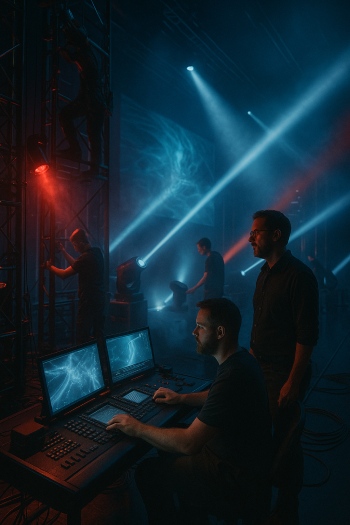
Today, advanced technological support is a must in improving performances and engaging the audience. Innovation in projection mapping, robotic lighting, and immersive sound systems empowers the creators to stretch the boundaries when it comes to stage." For example, by simply adjusting a certain set of projector settings, digital projections can transform a white space into a bustling, technologically driven cityscape or a tranquil, magical forest. Complex and advanced speaker configurations ensure that every member of the audience hears that performance whether up front or nestled in the very back.
Live Event Safety and Risk Management
Safety is the very base of performances; however, usually, audiences look to it as men of straw. Stage designers, technicians, and management cooperate to meet exacting safety guidelines for each set piece, prop, and rigging component. Included in this are safe installation, load testing for the flying elements, and electrical code compliance for lighting and sound equipment.
Beyond physical safety, risk management translates into crowd control, emergency exits, and viable pathways of action concerning inclement weather, equipment failure, etc. Consequently, safety rehearsals, as well as drills for safety contingencies, are always in existence in preparation for the unexpected, so that the performance and the audience enjoy a blessed time without any trouble. This is really the main invisible ingredient in production.
Special Effects and Illusions
The Spectacular effect is used during live events to enhance drama and create memorable moments that guests will never forget. Smoke machines, fireworks pyrotechnics, fog machines, and laser technology can help with this, but the use of such effect can be harmful if not carefully planned. Effects are important and must be timed with the music, performers' movements, and other lighting effects so as to avoid accidents and communicate the smoldering effect to the audience.
Illusions, such as trap doors, riggings, flying props, disappearing props within blocks of flashed smoke, are especially controversial elements in live performance such as theater. Great care must be taken by performers and technicians to ensure safety and optimal visual effect. When running smoothly, these special effects can go so far as to create a feeling of magic, uniting audiences and testifying to the art form.
Audience Engagement and Experience
Backstage, teams are always considering in what ways the performances can be as immersive and unforgettable as possible for the audience. The layout of the audience seating, the audience's perspective on sight and stage elevation is meticulously molded to ensure a perfect viewpoint for everybody. Acoustic ensuring clarity, and light angling guaranteeing that key moments are highlighted, yet without being shiny enough to distract or even blind the spectators themselves.
Timing and pacing also decisively influence the audience's experience. A sequence of events, from a well-computed scene change to suitable choices of music, supports the aim of either maintaining the tension or engendering emotion. Ushers, front-of-house staff, and stage managers are also involved in sending messages to the audience without being fully shown to them. This approach underlines the necessity of ensuring a seamless, memorable experience among the people in attendance- and the artist should not lose any of its live performance attributes.
Appreciating the Invisible Effort
An amazing crowd having the best performers, live sets are brought together by dedication, creativity, and problem-solving that lasts months. All this is a product of countless individuals, i.e., a lighting scientist, sound person, stage manager, actor, and the director, minimizing/obliterating whatever required personal credit. Such invisible work magnifies and extemporizes live events and opens our eyes to the devotion and ingenuity that goes into creating the kind of scenes and settings that last in anyone's memory. Here we find uncovered reprobation of artistry, by all on stage is that is part of the journey.